
🤖 Physical AI in 2026: The Moment Humanoid Robots Stopped Being a Joke
Humanoid robots are no longer just lab experiments. In 2026, powered by Physical AI, they are entering real-world pilot programs across industries. This shift marks the beginning of a new era where machines can perceive, reason, and act in dynamic environments—bringing us closer to practical, everyday robotics.
“We’ve been promised robots for decades. So what’s different this time?”
For years, humanoid robots lived in two places:
- Research labs
- YouTube demo videos
They danced. They flipped. They impressed.
But they didn’t work.
That’s changing—fast.
In 2026, something subtle but powerful is happening:
Humanoid robots are quietly moving from “look what we built” to “here’s where we’re deploying them.”
Welcome to the era of Physical AI.
🧠 What “Physical AI” Actually Means (And Why It Matters)
Most AI you’ve seen lives in the digital world:
- Chatbots
- Image generators
- Recommendation engines
But Physical AI is different.
It’s AI that can:
- See the world
- Understand context
- Make decisions
- Take action in real time
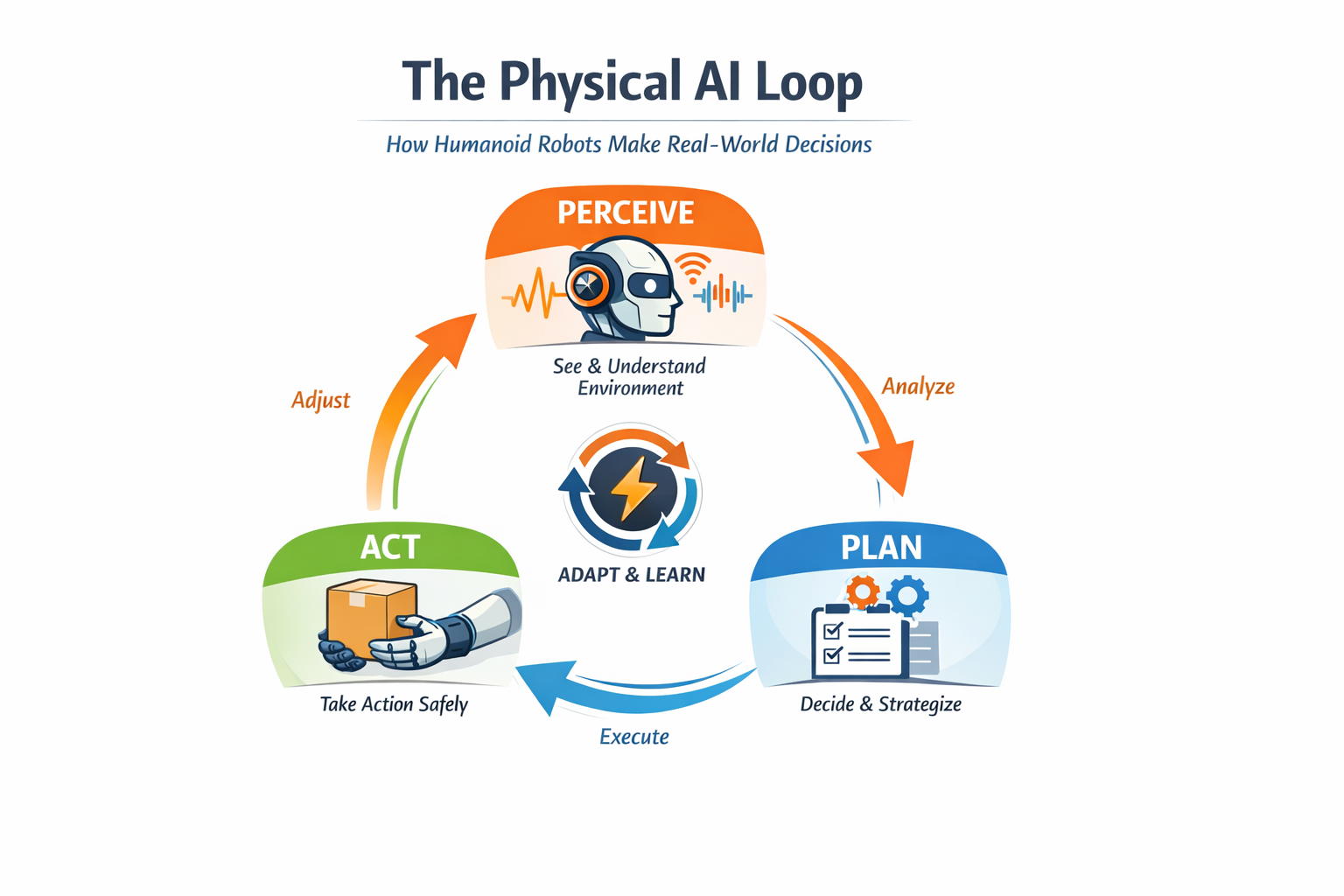
At its core, it runs on a continuous loop:
🔄 The Physical AI Loop (Perceive → Plan → Act)
This loop is what makes robots adaptive, not just automated.
They don’t just follow instructions—they adjust based on reality.
⚡ Why This Is Happening Now
This isn’t hype timing. It’s tech convergence.
1. AI Can Finally Understand Reality
Modern AI models can process:
- Vision
- Language
- Spatial awareness
That means robots can now follow instructions like:
“Pick up that item and place it on the shelf”
—not because they were programmed step-by-step, but because they interpret intent + environment.
2. The Robots Themselves Got Way Better
Companies like:
are building robots that are no longer experimental.
They’re:
- Stable
- Repeatable
- Designed for actual work
3. The World Suddenly Needs Them
Let’s be real:
- Labor shortages are rising
- Costs are increasing
- 24/7 operations are becoming standard
Robots aren’t just cool anymore.
They’re becoming economically necessary.
🏭 The Quiet Shift: From Demos to Real Work
Here’s what most people miss:
This shift is not loud.
It’s happening quietly through pilot programs.
- Agility Robotics → logistics deployments
- Figure AI → industrial partnerships
- Tesla → internal testing
🧩 What a Real Robot Actually Does
In reality, even a “simple” task like picking up an object involves:
- Seeing the object
- Understanding its shape/position
- Planning movement
- Executing safely
- Adjusting in real-time
This continuous loop is what separates real robots from demos.
🤝 The Part Everyone Underestimates: Humans
Here’s the twist:
The hardest problem isn’t the robot.
It’s us.
Research from the Luxembourg Institute of Science and Technology shows:
Adoption depends on trust, collaboration, and communication.
Because in reality:
Robots won’t replace humans first—they’ll work beside them.
⚠️ Let’s Kill the Hype (For a Second)
Before you imagine full automation…
We’re still early.
Challenges:
- High costs
- Limited autonomy in chaotic environments
- Safety + regulations
- Edge-case failures
Robots today are good at:
👉 Structured, repeatable tasks
They still struggle with:
👉 Messy, unpredictable reality
🚀 So What’s the Big Deal?
Because this moment feels familiar.
Like:
- The early internet
- The first smartphones
- The rise of cloud
First:
“This is interesting.”
Then:
“This is useful.”
Then suddenly:
“Everything depends on this.”
We’re right in the middle.
🔮 What Happens Next?
Short term (1–3 years):
- More pilots
- Warehouse + factory use cases
- Human + robot collaboration
Mid term (3–7 years):
- Lower costs
- Better autonomy
- Wider adoption
Long term:
- Robots become as normal as computers at work
💡 Final Thought
Humanoid robots didn’t suddenly become magical.
They became:
Just useful enough.
And historically…
That’s when everything changes.
Originally published on RobotAIGeek.